
Inspector: YuCe Live
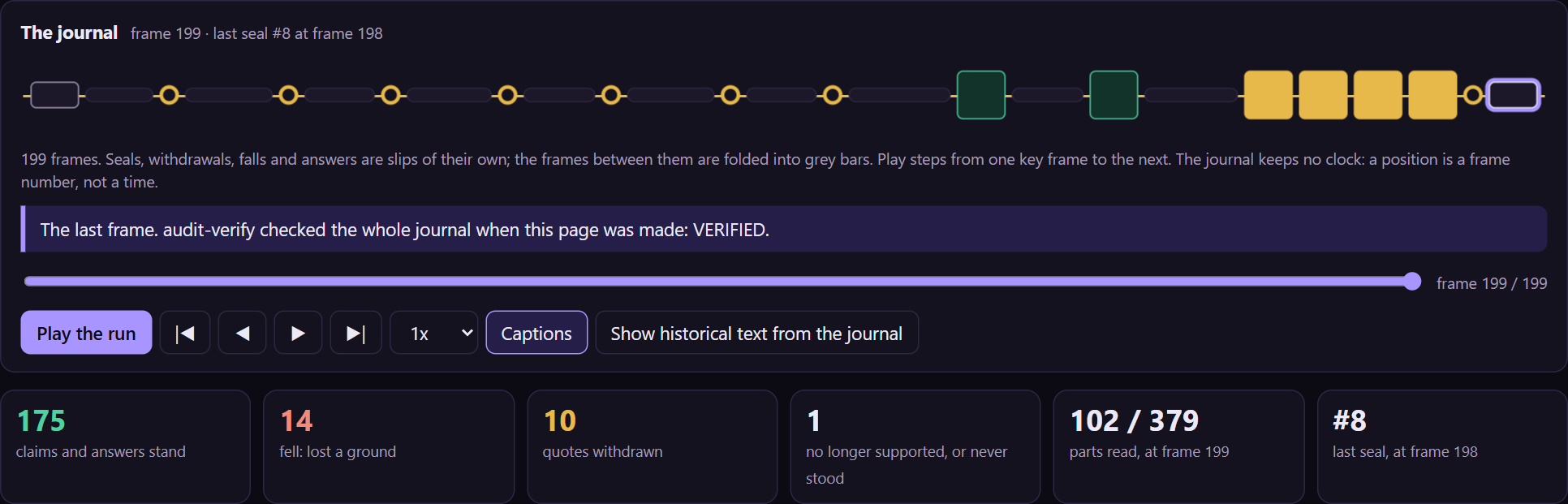
One page made from a journal. It plays a recorded run back frame by frame: what the kernel accepted, what each claim rests on, and what fell when a sentence was withdrawn. Each state on it is the kernel’s own answer for that frame.
Nothing on this page, or on the page it opens, runs the kernel or calls a model. The run was recorded with YuCe 0.2.2: three readers, one run, 66 model calls. The page reads only its journal.
The page is in English and makes no network request.
The run
- The documents: two editions of the JSON specification, RFC 4627 (2006) and RFC 7159 (2014), byte for byte from the RFC Editor: two files, 43,770 bytes.
- The readers: three, working through the kernel on two questions, in one run.
- The withdrawals: four sentences, one after another, each a sentence that a later edition changed. This is an intervention made for the benchmark: the IETF withdrew none of them.
- What fell: the quotes that stood on each withdrawn sentence and the records that rested on them, 10 quotes, 10 claims and 4 hypotheses in all. A sentence that no edition changed stood to the end, with its 6 quotes and the 4 claims that rest only on them.
What this run does not show
- No answer rested on a withdrawn sentence, so no question was sent back: the run shows the cascade on the readers’ records, not an answer kept or repaired after a withdrawal.
- One run, with no repeat and no side without the kernel to compare with.
- The page shows what the journal holds. The journal keeps no clock, so a position is a frame number, not a time; the text of a record that fell stays hidden unless you ask for it.
- A journal that verifies is consistent with itself. To trust that it is the journal the writer kept, keep a receipt or a signed checkpoint where the writer cannot change it.
Check it yourself
The journal is a file of the release v0.2.2. The page is made from it by a script of the open repository, and every state on the page is compared with the kernel’s own answer at every frame. With the kernel of the release:
tar -xzf jsonrfc-run1-K.tar.gz
sha256sum jsonrfc-run1-K/arm_c/run.wal   # 0552cfb91e7051d9b8bbf16b78f1d59765b7a079ee83db3704496d447ac9d3e0
sbgk audit-verify --wal jsonrfc-run1-K/arm_c/run.wal
python examples/live-journal/make_page.py --wal jsonrfc-run1-K/arm_c/run.wal --docs jsonrfc-run1-K/inputs/repo --out page.html
In the open repository
- The release
The journal and the documents of the run: jsonrfc-run1-K.tar.gz, with its manifest and SHA-256 sums.
- examples/live-journal
The script that makes the page, with its README.
- The corpus
The two RFC files, the reference and the plan of the withdrawals.
- BENCHMARKS.md
What was measured in this run, and what it does not show.
The RFC texts are copyright of the IETF Trust and the Internet Society and of their authors, reproduced unchanged under BCP 78 and the IETF Trust’s Legal Provisions, to pin the bytes of a benchmark.